



- Homepage
- Announcements
- Acoustics and Vibration Academy (AVA)
- Acoustic Events & Exhibitions
- Key Dates
- Congress Venue
- Distinguished Plenary Lectures
- Brochure
- Committees
- Program at a Glance
- Scientific Programme
- Submission Templates & Guidelines
- Social Programs
- Registration Fees and Details
- Accommodation
- Invitation Letter & Visa
- Sponsorship & Exhibition
- Exhibitors & Sponsors
- Student Paper Award
- Terms and Conditions of Attendance
- Publication Ethics and Malpractice Statement
- Editorial policy
- Contact Us
- IIAV

ACOUSTICS AND VIBRATION ACADEMY (AVA): Current trends and advanced methods in acoustics and vibration
(July 4-5, 2026)
This event aims to introduce advanced educational modules combining theoretical foundations with practical applications in three thematic areas.
During the two days program the event will present theory, newly emerging methods and systems to provide advanced-level training designed for both graduate-level students with fundamental knowledge in acoustics and/or vibrations, and professionals working in the field.
Professionals participating in this academy will receive a "certificate of participation". Students, upon request, may obtain a certificate indicating that the training activity has been evaluated as 1 ECTS credit, provided that they complete an additional preparatory assignment and take an examination at the end of the training.(The awarded 1 ECTS credit is recorded in the Diploma. Supplement at the students' home universities within the scope of the Micro-Credential System.)
PROGRAM AT A GLANCE: July 4-5, 2026 (2 days)
- 1,5 days: Lectures & practical exercises
- Half a day: Workshops & hands-on measurements
- 10-30 minutes: Sponsor presentations
- 30-60 minutes: Exam – for students who want to have it as credits
TARGET GROUP: 30 participants x 3 topics - Acoustics and/or mechanical vibrations students with at least basic knowledge + professional development of graduates (special prerequisites can be defined as requested by educators)
PARALLEL EDUCATION MODULES:
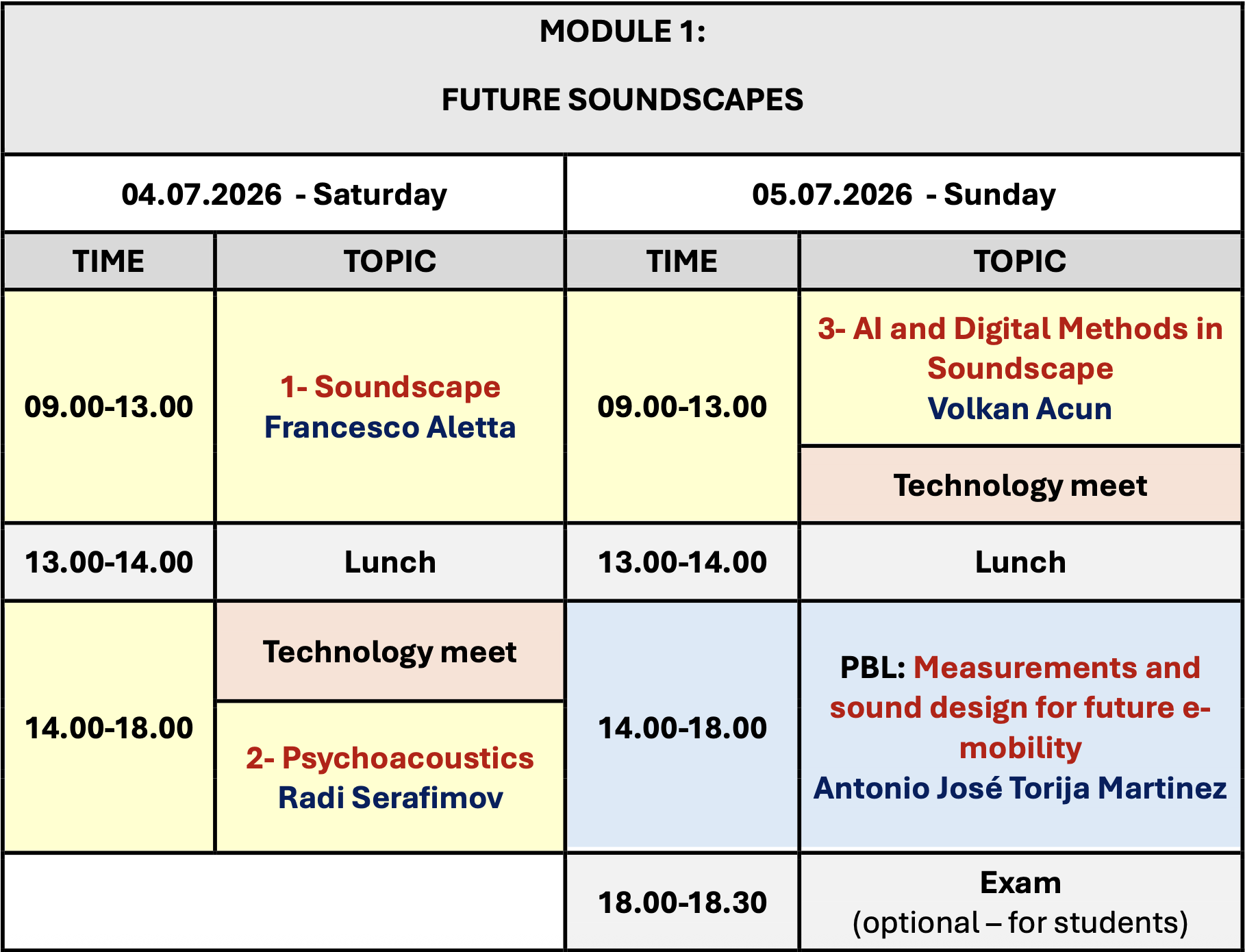
Module 1: Future Soundscapes
Organiser:
- Francesco Aletta, University College London
Educators:
- Francesco Aletta, University College London, UK
- Antonio José Torija Martinez, University of Salford Manchester, UK
- Volkan Acun, University of Salford Manchester, UK
- Radi Serafimov, HEAD acoustics, Germany
This module covers;
- Lectures & practical exercises: soundscape, psychoacoustics, AI in soundscape
- Hands-on: sound design for future e-mobility
- Exam (optional – for students)
Theory:
The Future Soundscapes module is an advanced training course focused on contemporary methods for soundscape assessment and prediction, grounded in the ISO 12913 framework. The course explores soundscape theory, human perception, and psychoacoustics as the basis for structured data collection, analysis, and interpretation across indoor, outdoor, and natural environments.
Participants will engage with current soundscape assessment methodologies, soundscape indicators and descriptors, and the theory behind and application of soundscape prediction models. The training also introduces emerging analytical approaches, including AI-assisted data processing and modelling, and considers how these tools can support evidence-based design, planning, and decision-making within existing regulatory and standards-based contexts.
PBL: Perception-Driven Design in Acoustics
This course introduces perception driven design in acoustics, moving beyond traditional sound level approaches. It aims to explore state of the art methods including auralisation, psychoacoustic testing, and advanced noise and sound quality metrics. Furthermore, the course examines practical applications and success measures to enhance acoustic design aligned with human perception.
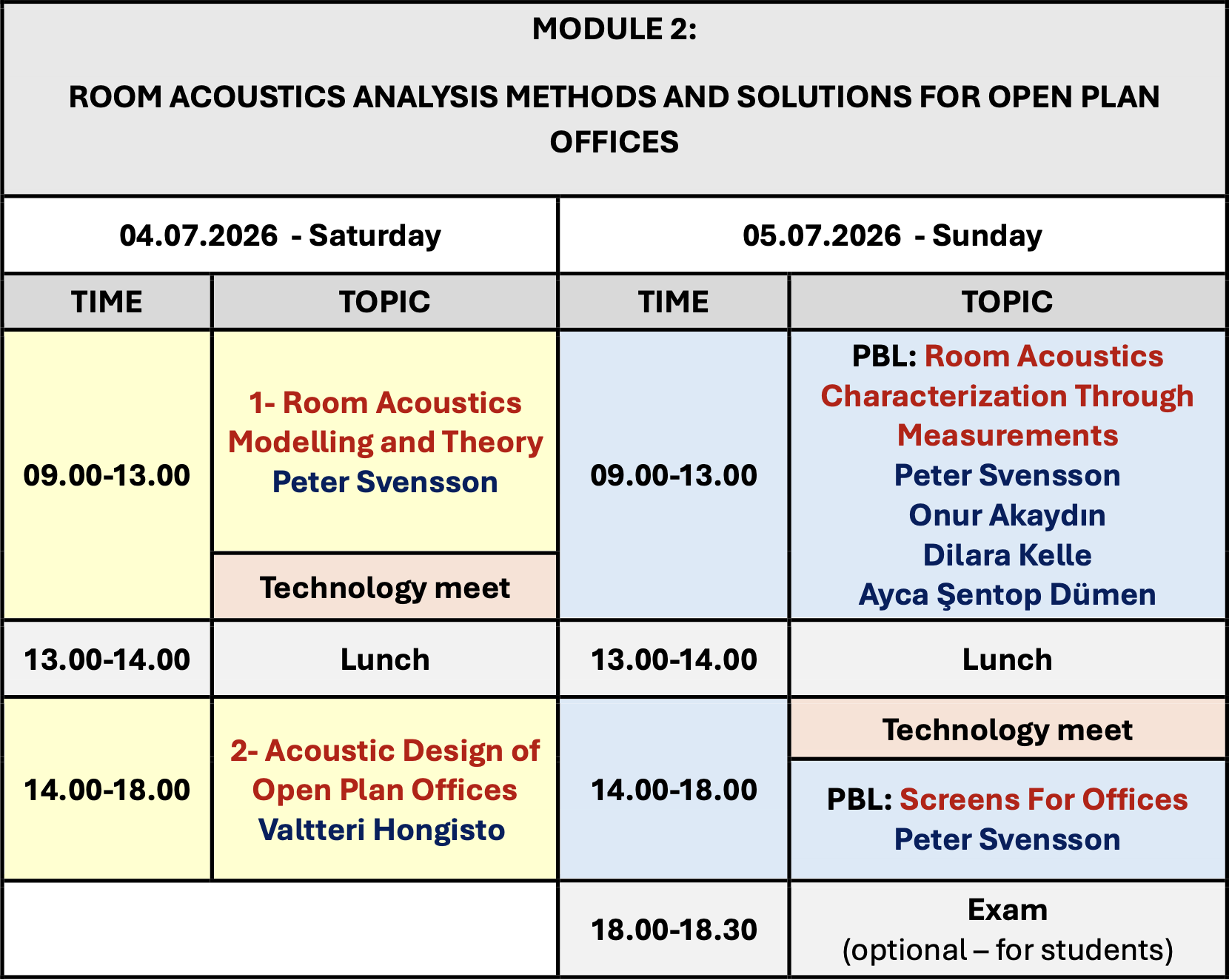
Module 2: Room acoustics analysis methods and solutions for open plan offices
Organiser:
- Peter Svensson, Norwegian University of Science and Technology, Norway
Educators:
- Peter Svensson, Norwegian University of Science and Technology, Norway
- Valtteri Hongisto, Turku University of Applied Sciences, Finland
This module covers;
- Lectures & exercises: room acoustics modelling & theory, function-specific problems, parameters and solutions, introduction of ISO 3382-3:2022 and, ISO 22955:2021 on measurement and quality, analysis of measurements, screen design for open plan offices
- Hands-on: measurement of screen effectivity based on different layouts
- Exam (optional – for students)
Theory:
This course provides an integrated overview of room acoustics for open-plan offices, combining theoretical foundations, measurement methods, noise control solutions and a case study on acoustic screens.
It gives a short review of fundamental room acoustics theory, with a focus on geometrical acoustics and diffuse-field theory. The concepts of coupled spaces and noise barriers, and their relationship to open landscape offices, will then be discussed in more detail. Possibilities and limitations for geometrical acoustics-based methods and typical room acoustic simulation software will be discussed. Function-specific acoustic criteria, ISO 3382-3 methods, and noise control solutions will be introduced together with case studies.
PBL: Room Acoustics Characterization Through Measurements
This study evaluates a demo room under two conditions. Initial measurements include A-weighted SPL of speech, background noise, STI, and ISO 3382-3 parameters, compared with predictions using an online regression model. In the modified setup, screens are added, and the same procedures are repeated to assess their impact on acoustic performance.
PBL: Screens For Offices
This study presents an analysis of measurement results, simulations, and the overall acoustic performance of the demo room (with and without acoustic screens), and assesses acoustic improvements using an online model.
Module 3: Non-Linear Modal Analysis and Substructuring
Organiser:
- Nevzat Özgüven, Middle East Technical University, Turkiye
Educators:
- H. Nevzat Özgüven, Middle East Technical University, Turkiye
- Matt Allen, Brigham Young University, USA
- Dario Di Maio, University of Twente, Netherlands
This module covers;
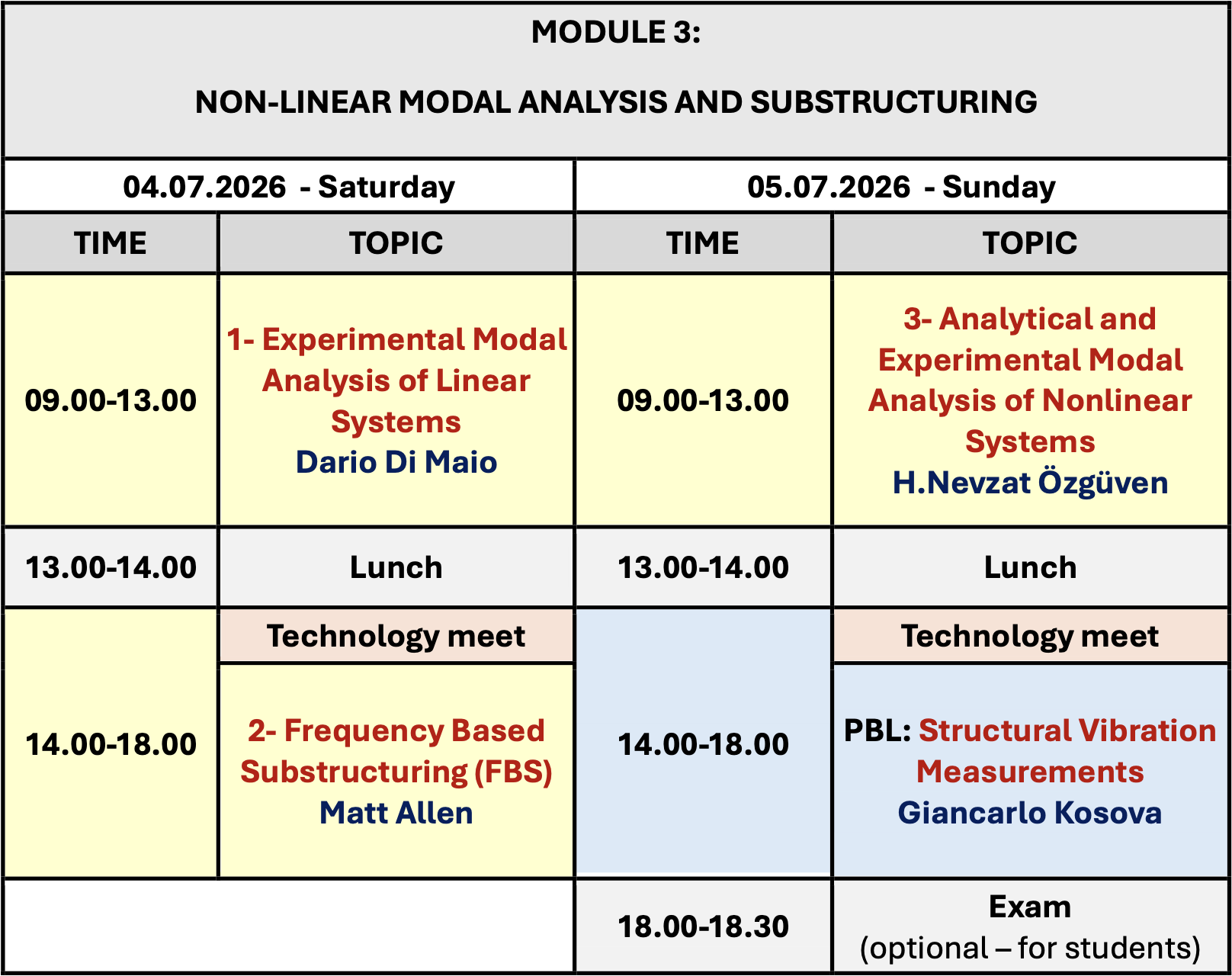
- Lectures & exercises: modal analysis of linear systems, frequency based substructuring, analytical and experimental modal analysis of nonlinear systems
- Hands-on: vibration measurements
- Exam (optional for students)
Theory:
The Experimental Linear Modal Analysis module will focus on deriving modal properties from Frequency Response Functions (FRFs). The course is focussed on Single and Multi-Degree of Freedom systems for which many intuitive analysis techniques will be explained and applied. Moreover, examples of FRF visualisations will show how to inspect the linearity of an FRF.
A frequency based substructuring (FBS) framework is used to cover linear substructuring fundamentals such as compatibility, equilibrium and primal/dual assembly. Interface considerations are reviewed including virtual point transformations and the transmission simulator method. Modal substructuring methods are also briefly introduced, as well as their relationship to interface reduction.
Analytical and experimental modal analysis of nonlinear systems will be investigated based on the quasi-linear property of nonlinear systems. Response-controlled harmonic testing provides quasi-linear FRFs from which a response-dependent modal model of a nonlinear system can be derived. Applications of the method on benchmark structures and complex engineering systems will be presented.
PBL: Structural Vibration Measurements
This workshop offers a live demonstration of structural vibration measurements. Learn practical techniques like FRF acquisition using impact or shaker testing, and perform experimental modal analysis with commercial software. Discover pre-test optimization, model correlation with FEA, and how to leverage experimental data for advanced research. This workshop complements the theory sessions.
Who should attend?
This course is designed for practicing engineers, students, and faculty interested in gaining a deeper understanding of linear and nonlinear modal analysis and frequency-based substructuring.
Modules are limited to 30 participants.
The registration fee for the education modules is USD 150 (approximately EUR 125). Participants are required to register via this website starting from February 20th, 2026.
You can register either "here" or directly via the "AVA Registration" option in Participant's section of the menu on the right.
This event is intended for continuing education of professionals working in the field and graduate students with at least a fundamental background in acoustics.
Students may apply for AVA participation grants. Scholarships of USD 150, covering the registration fee will be awarded to 10 students each.
To be eligible for this grant, applicants must be young acousticians and/or students studying mechanical vibrations, currently enrolled in a Master’s or PhD program, and under 35 years of age. Priority will be given to students from underrepresented groups, including women, and according to the order of registration.
The scholarship recipients will be informed by email, and the amount paid will be refunded to their accounts.
Grant Application Documents:
- CV and one-page professional biography.
- A brief recommendation letter from the supervisor.
- Student certificate
- Academic transcript
Please combine all the documents listed above into a single PDF file and email it to satellite-event@icsv32.org. The subject line of the email should be AVA Student Grants Application_your initials.

|

|

|
||
|
Bilge San Ozbilen |
Ayca Sentop Dumen |
Papatya Nur Dokmeci Yorukoglu |
||
|
||||
|
||||


ABOUT MIMAR SINAN FINE ARTS UNIVERSITY (MSGSU) - CONSTRUCTION RESEARCH CENTRE
The objectives of the Center are to provide researchers with a research environment equipped with advanced technical infrastructure that enables the use of contemporary scientific methods and techniques in matters related to buildings and their environment; to support scientific research conducted in collaboration with industrial organizations; to contribute to the University’s relevant educational programs; and to assist and collaborate with national and international institutions, organizations, and individuals in analyses they request.
Click here for more information and examples of the Center’s activities.

Participant's area I forgot my password Create a new account |
Photos of Istanbul  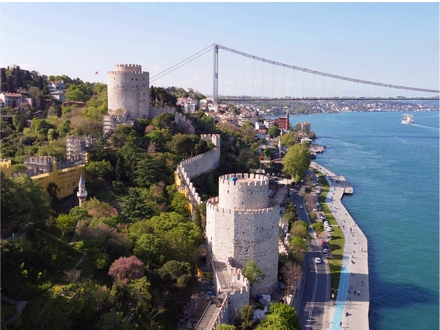   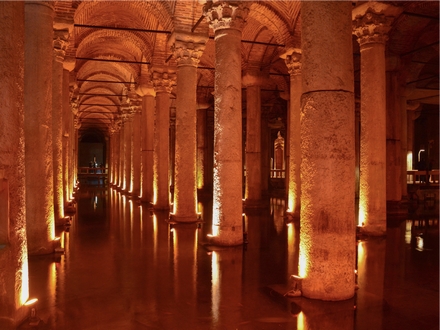                    |
 |
ICSV32 will begin in
Days
Hours
Minutes
Seconds
|